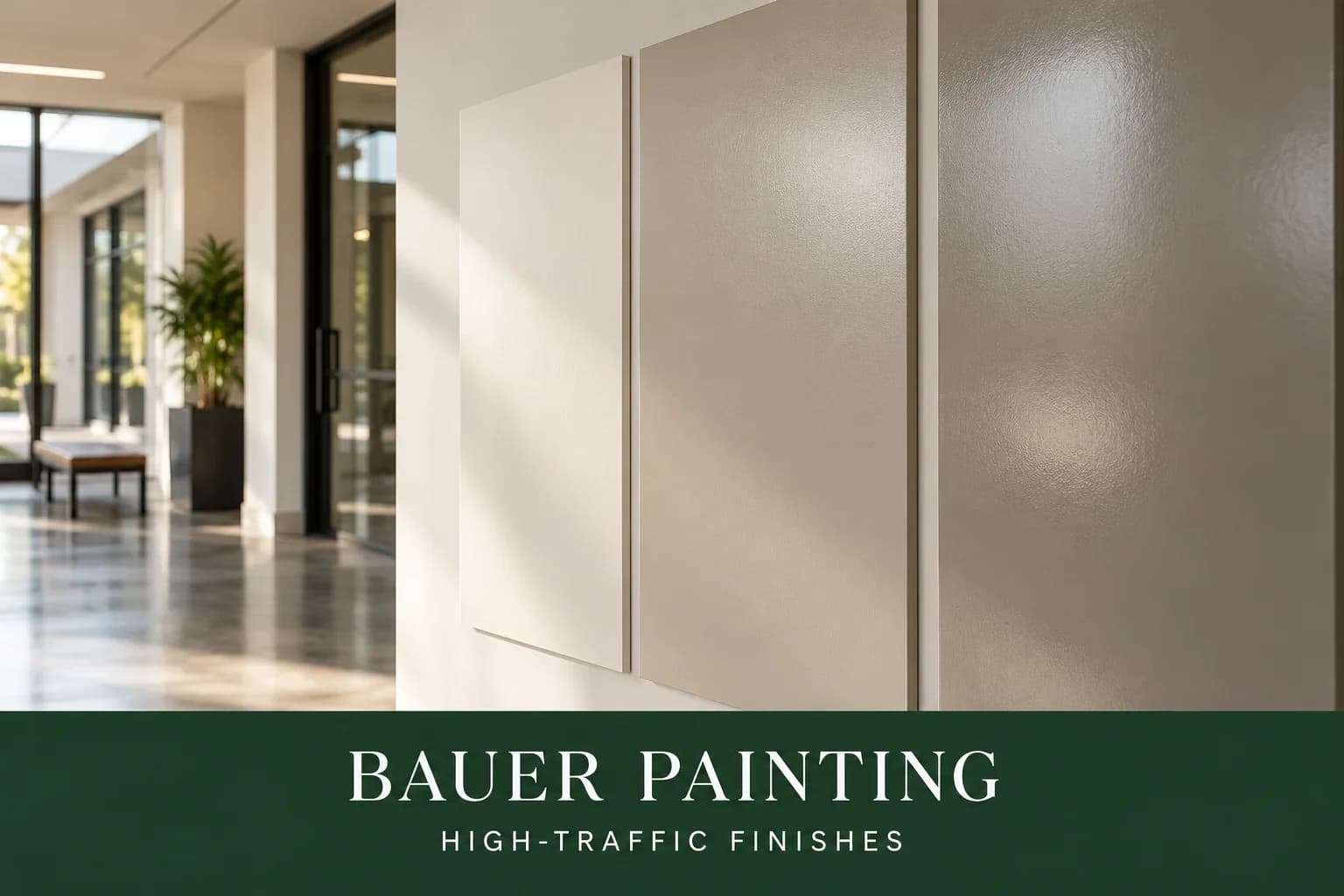
High-traffic interiors are not all exposed to the same kind of wear. A reception wall may be cleaned repeatedly, a corridor corner may be struck by equipment, and an office door may receive concentrated hand contact. Calling all three areas busy does not explain what a coating must withstand or what the maintenance team will do after the project is complete.
For commercial property managers in Toronto, Mississauga and the Greater Toronto Area, the useful starting point is a surface-and-use review. This guide explains how to compare commercial paint finishes, ask better product questions and prepare a maintainable scope for commercial interior painting. The objective is a system that fits the property, with a clear record of what was approved and how the finish should be cared for.
What do commercial paint finishes and sheen labels describe?
Sheen describes how a paint film reflects light. Labels such as flat, matte, eggshell, satin, pearl and semi-gloss help organize appearance choices, but they are not complete performance specifications. Compare the exact product and its technical information rather than assuming that similarly named finishes from different ranges are interchangeable.
Compare physical finish samples in the lighting where they will be used. Reflected light can change how colour, texture and repaired surfaces appear. Record the approved product and sheen alongside the sample location. Assess cleaning, wear and substrate requirements separately from visual preference, and confirm any limitations before ordering materials. The chosen appearance is one part of the specification, rather than the entire basis for selecting a coating.
Does a higher sheen always make a commercial wall more durable?
No. Sheen alone cannot establish whether a particular coating is suitable for the service expected. Formulation, substrate condition, preparation, application and maintenance all influence the result. Ask what the proposed product is designed to do and what evidence or technical guidance supports that use. A rule that every busy wall needs the glossiest finish can overlook other important requirements.
Separate appearance from the type of wear. Scuff marks, staining, abrasion and impact are different problems. A product selected for one condition should not be described as a solution to all of them. Where equipment repeatedly strikes a corner, discuss physical protection or circulation changes alongside paint. A coating cannot reasonably be expected to replace damaged substrate or prevent every collision.
How should you define high traffic before choosing paint?
Walk the space with the people who use it and the team responsible for cleaning. Identify the surfaces that receive contact, the source of recurring marks and the maintenance response. Record the location and extent rather than describing the entire building as high traffic. A photograph of a recurring problem and a clear description of use are useful parts of a contractor brief.
Public corridors: note bags, trolleys, furniture movement and repeated contact at corners.
Reception areas: identify presentation requirements, hand-contact points and cleaning frequency.
Office doors and frames: record handling, existing material, hardware and operating constraints.
Shared amenities: describe expected use, moisture conditions and the cleaning products in use.
Low-contact ceilings: review appearance, existing coating and access rather than assuming wall requirements apply.
Add the observed cleaning routine to the register. The contractor needs to know whether the surface is occasionally wiped or regularly cleaned with a defined product. Where the current finish is unknown, say so. This helps the project team identify questions that must be resolved instead of selecting a coating around an assumption that cannot later be checked.
What is the difference between washable, scrubbable and scuff-resistant?
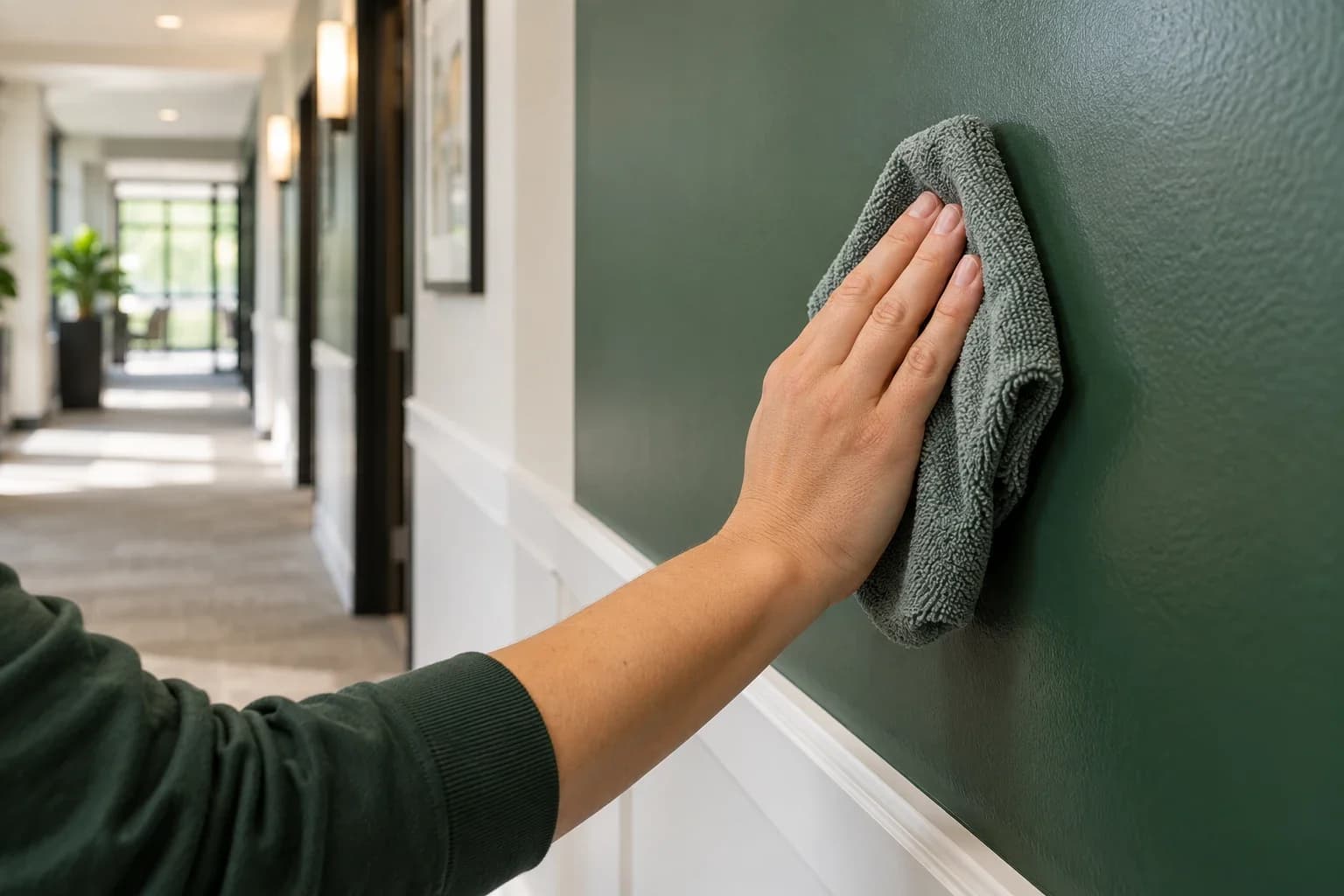
Treat these terms as prompts to investigate the actual product, not as interchangeable guarantees. A coating may be marketed around resistance to marks, cleaning performance or another defined characteristic. Ask which claims apply to the proposed product and finish, how the manufacturer describes them, and what cleaning or service conditions are assumed.
The BEHR guidance on poor scrub resistance identifies product selection and service conditions as relevant considerations. Use manufacturer guidance to ask specific questions, rather than transferring one product's claims to every commercial paint. If repeated cleaning is a requirement, include the actual cleaning method in the discussion before approval.
A coating that withstands a particular cleaning method does not automatically resist impact, hide substrate defects or tolerate every chemical. Ask for an appropriate system for the actual exposure. For more demanding surfaces, our high-durability commercial coatings service provides a starting point for a scope discussion without treating every interior as a specialist coating project.
Which decisions belong to walls, doors and ceilings?
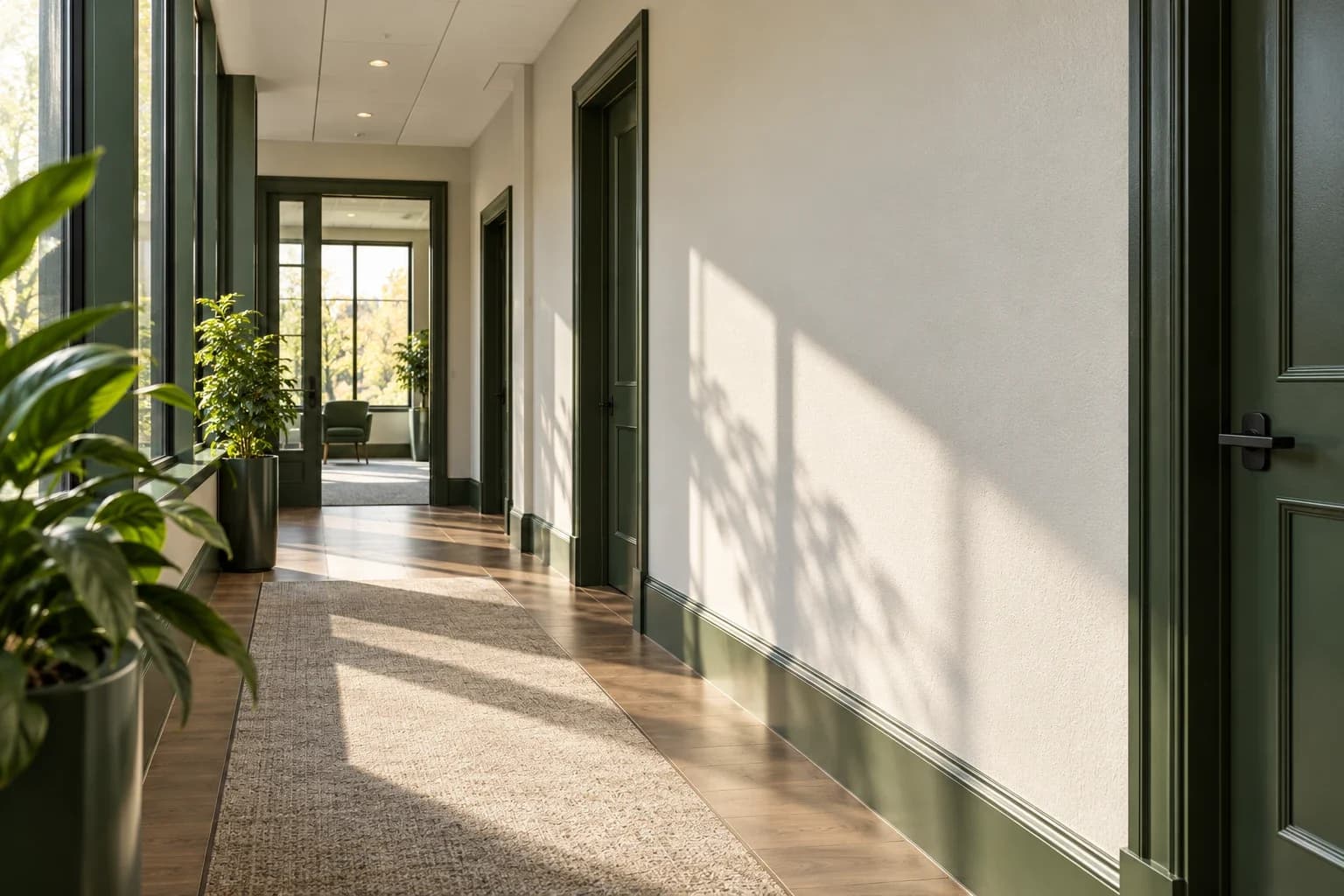
Give each surface its own assessment. Walls need consideration of appearance, repair visibility, contact and cleaning. Doors and frames need assessment of their material, existing film and handling requirements. Ceilings may have different appearance and access priorities. A single colour palette does not require a single coating system throughout the building.
For doors, define whether frames and edges are included, how hardware and seals will be protected, and how access will be maintained. Do not assume that a door can be handled normally as soon as the surface feels dry. The proposed product and work sequence should establish the conditions for handling and return to service.
For walls beside damaged corners or fixed equipment, identify any repair or protection dependency before selecting a final finish. For ceilings, clarify fixtures, vents, adjacent finishes and access equipment. These decisions keep the quotation connected to the surfaces that will actually be painted, rather than leaving a general allowance that different bidders interpret differently.
Why does preparation matter as much as finish selection?
A coating needs a suitable, sound base. Contamination, loose existing paint, poorly prepared repairs or unresolved moisture can undermine the result regardless of sheen. Ask the contractor how the substrate and existing film will be assessed, what preparation is proposed and what remains uncertain before work starts.
Keep preparation descriptions specific. Cleaning, filling, surface abrasion where appropriate, priming and replacing damaged materials are different tasks. Some repairs or unknown materials require further assessment or another trade. A written proposal should distinguish those responsibilities instead of implying that painting preparation includes any building repair that might be discovered later.
Include an approval route for additional work. If preparation exposes a condition outside the original brief, identify who can review it, agree the response and authorize any cost or schedule change. This is particularly important in managed properties where the tenant, property manager and building owner may have different responsibilities. Our painting process explains how assessment fits into a defined project discussion.
How do lighting and colour affect finish approval?
Approve samples in the lighting in which the finished surface will normally be seen. Daylight and installed lighting can reveal different aspects of colour, sheen and surface texture. Review a long corridor from its usual approach and look at walls near windows from more than one position. A small card held at a desk cannot answer every question about a large finished area.
A sample board can support an initial comparison of colour and sheen. An agreed sample area on the actual surface can help address preparation and appearance questions. Record which product, colour and finish were approved, who approved them and whether the sample represents the proposed work. Without that record, a remembered colour name can become a poor substitute for a specification.
Where a building has brand standards, clarify who has authority to approve a variation. If an existing finish has aged, do not promise that a new touch-up will be invisible. Review whether the proposed repair can meet the appearance required, or whether a larger natural boundary provides a more consistent result. Keep the approved approach visible in the scope.
When can a newly painted surface be cleaned?
Use the selected product's care and curing instructions. Drying, recoating, handling and full service performance are different stages. A surface that feels dry is not automatically ready for routine washing or repeated contact. Ask for written instructions at handover so cleaning staff do not have to infer readiness from appearance or smell.
The Sherwin-Williams maintenance and repair FAQs discuss cleaning precautions and checking a method in an inconspicuous area. That is useful background, but the directions for the product applied to your property should govern care. Avoid adopting a cleaning interval from another coating without checking that it applies.
Specify which cleaning products and tools will be used after the work. Agree a suitable method with the relevant product information, and record any restrictions. Increasing cleaning pressure or changing chemicals repeatedly is not a reliable way to solve a finish problem. If a surface changes sheen or marks persist, document the condition and request a review before continuing a method that may worsen it.
Should you touch up marks or repaint the full wall?
Compare the condition of the existing finish, the size and location of the repair, and the appearance required. Touch-ups can remain noticeable because of weathering indoors, batch differences, repair texture, application or sheen variation. A technically sound local repair may not produce the visual blend expected across a large uninterrupted wall.
Ask the contractor to explain the options and their boundaries. One proposal may repair a defined area; another may repaint to an architectural break. Evaluate preparation, protection, access and appearance together. If the same location needs repeated repair, investigate the cause of wear rather than assuming more frequent painting is the only maintenance strategy.
If the decision forms part of an office refresh, our office repainting guide helps identify which rooms and surfaces deserve attention. Keep this finish-selection discussion focused on the coating system and maintenance needs, while the wider office plan addresses the timing, priority rooms and operational arrangements.
What should a commercial finish schedule include?
A finish schedule should allow someone who was not present during colour approval to identify the intended treatment. Organize it by room or surface, with clear location names. Keep product and appearance decisions together, and identify any outstanding approvals before materials are ordered or a work area is released.
Room, floor, elevation or other location identifier.
Surface material and relevant existing-condition notes.
Preparation and primer requirements or assessment allowances.
Manufacturer, exact finish product and approved sheen.
Colour reference and sample approval record.
Areas excluded, retained or assigned to other trades.
Handling, cleaning and return-to-service information to be provided.
The schedule also helps property teams compare quotations. Two proposals using the same colour name may include different preparation, products or surfaces. Ask bidders to identify substitutions and explain them before approval. A clear written record makes it easier to review both the immediate work and later maintenance without relying on a broad phrase such as premium commercial paint.
How should GTA property managers compare overall value?
Compare the defined scope and expected service requirements, not only the price of the paint. Preparation, access, protection and repeated setup can be important parts of a project. Ask how each option addresses recurring wear and what maintenance information it provides. Avoid treating an unsupported lifespan claim as a substitute for a suitable specification.
For properties in Toronto, Mississauga and Oakville, supply the actual building address and area list. A city name does not establish the cleaning routine, wall condition or access restrictions of a particular property. Those details need to come from the site and its responsible team.
Where the building will remain occupied, use our occupied-building painting guide to coordinate stages and handover. Product suitability and project sequencing are connected, but they answer different questions. Agree both before setting expectations for how quickly a room can be used or cleaned after the painting work.
Prepare a practical commercial paint finish brief
Gather condition photographs, a surface list, known product records and the cleaning routine used by your maintenance team. Identify which decisions concern appearance and which concern recurring contact or damage. Record the approved samples and the person authorized to make the final decision. These details turn a vague request for a durable finish into a brief that can be assessed.
Contact Bauer Painting to discuss suitable finishes for your commercial interior. Learn about the Bauer Painting team and our painting services for property managers. The next step is a defined scope based on the actual surfaces, use and maintenance requirements, with records that remain useful after handover.
Frequently asked questions
What is the best paint finish for a high-traffic commercial interior?
There is no single finish for every busy area. Compare the actual surface, contact, cleaning routine and appearance requirements with the proposed product information. Walls, doors and ceilings may need different systems, and recurring impact may require measures beyond a paint change.
Is a higher sheen always more durable?
No. Sheen describes reflected light, while performance also depends on formulation, preparation, application and maintenance. Compare exact products and their intended service rather than ranking coatings only by gloss level. Approve appearance and performance requirements as separate parts of the specification.
Are washable, scrubbable and scuff-resistant paints the same?
Do not treat those descriptions as identical guarantees. Ask what the manufacturer claims for the specific product and finish, which conditions apply and how the surface should be maintained. Resistance to one type of marking does not automatically establish resistance to impact or every cleaning chemical.
Should commercial doors use the same paint as the walls?
Not automatically. Doors and frames can have different materials, existing finishes and concentrated handling. Identify their preparation, product system, hardware protection and return-to-service requirements separately. A shared colour palette does not require every surface to use the same coating.
How should a commercial paint sample be approved?
Review the proposed colour and sheen under the lighting normally used in the space. An actual-surface sample can help resolve preparation and appearance questions. Record the product, colour reference, finish, sample location and authorized approver so the decision can be followed during the work.
When can newly painted commercial walls be cleaned?
Follow the exact product care and curing directions. Dry-to-touch does not necessarily mean ready for washing or repeated contact. Ask for written instructions at handover, including the approved cleaning method and any restrictions, so maintenance staff do not have to guess.
Why can wall cleaning leave a shiny patch?
A change in appearance can result from the finish or the cleaning method rather than remaining dirt. Stop increasing pressure or changing chemicals without review. Document the condition, check the product guidance and discuss the observed problem with the relevant supplier or contractor.
Can touch-up paint always blend into an existing wall?
No. Ageing, colour, sheen, repair texture and application can make a touch-up noticeable. Ask whether local work will meet the appearance required or whether repainting to a natural boundary is more suitable. Agree the treatment and acceptance area before extending the work.
What should a commercial finish schedule record?
List the location, substrate, preparation, primer where required, exact finish product, colour and sheen. Record sample approvals, exclusions and care information. A person who was not involved in selection should be able to identify the intended treatment without relying on a remembered colour name.
What should I send Bauer Painting when asking about commercial finishes?
Send the address, surface list, condition photographs, current product records if available, and the cleaning routine. Explain recurring contact or damage and your appearance priorities. Include access and occupancy constraints so system selection and the work plan can be discussed together.
Join the conversation
Have a question or a useful tip? Leave a comment for our team and readers.
Loading comments…